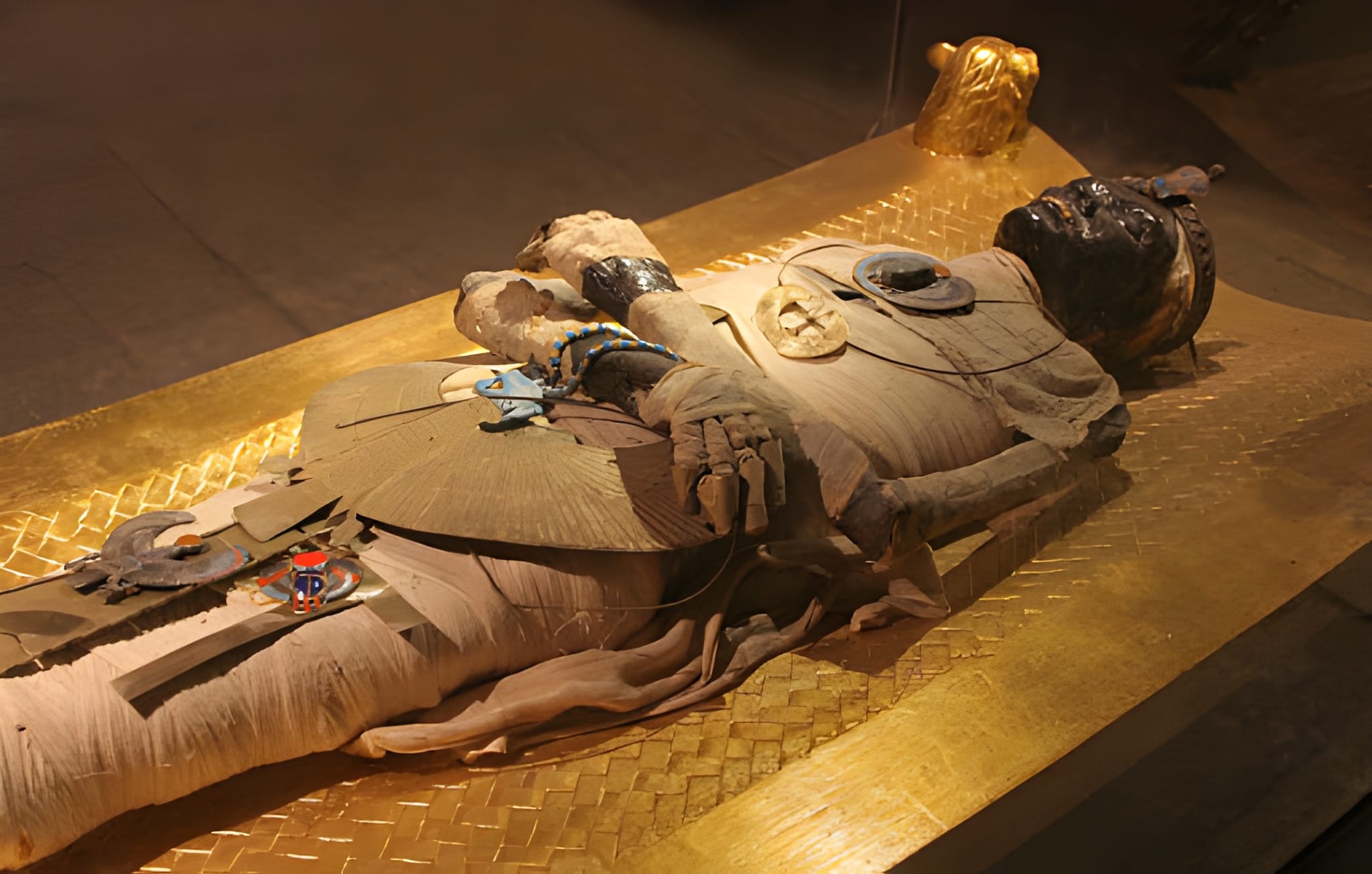
Mummification is the part of ancient Egypt that everyone half knows. The outline is familiar, the details are usually wrong, and the reason behind it rarely gets explained at all. It was not an attempt to cheat death. It was a technical procedure in the service of a belief: that a person survived only if the body survived with them, recognizable and whole, as the anchor for the parts of a human being that could not be buried.
This guide walks through the process in seven stages, from the first washing to the sealing of the tomb, and says what each stage was for. It also separates what the embalmers left behind as evidence from what later writers reported second hand.
Why They Did It, and the Historically Attested Stages
A Note on the Phrase "Seven Steps"
The seven-step list is a modern teaching device, not an ancient checklist. No Egyptian text sets out a fixed sequence of seven named stages for all periods and all workshops. What the evidence shows is a set of operations - purification, removal of organs, drying, anointing, wrapping, masking, ritual and burial - whose order was stable, whose details varied widely, and whose scale depended on what the family could pay. The numbering below follows the familiar modern order because it is a useful way to walk through the process.
Egyptian thinking divided a person into parts. The body was one, and the others, including the ka and the ba, needed it to return to. A destroyed body meant a destroyed person, which is why tomb robbery was a religious crime and not only a theft.
The practice ran for thousands of years, from simple natural drying in desert sand to the elaborate royal workshops of the New Kingdom and back to cheaper, faster methods in later periods. The seven steps below describe the developed version.
Step One: Washing and Purification
The body was washed, often with water from the Nile and a solution of natron salt. The washing was practical, because the work that followed had to start clean, and it was ritual, because purification in Nile water opened every formal act in Egyptian religion.
Where the Work Happened
Embalming took place in a workshop near the river, sometimes a tent structure, with separate spaces for the purification and the drying.
Step Two: Removing the Internal Organs
The embalmers removed the organs that decay fastest. An incision in the left side gave access to the stomach, intestines, lungs and liver. The brain was taken out through the nose with hooked instruments and discarded, because it was not considered the seat of anything.
Why the Heart Stayed
The heart was left in place, or replaced after treatment. The Egyptians located thought and character there, and the heart had to be present to be weighed against the feather of truth in the judgment scene.
Canopic Jars
The four removed organs were dried, wrapped and placed in four jars, each under the protection of one of the four sons of Horus, whose heads formed the lids in later periods.
Step Three: Drying With Natron
The body was packed and covered with natron, a naturally occurring salt mixture collected from dry lake beds. Natron draws out water, and water is what decay needs. The body was left in it for about forty days.
What the Drying Did to the Body
It lost most of its weight and all of its moisture. Afterward the embalmers packed the empty cavities with linen, sawdust or resin-soaked material to bring the shape back, because a recognizable form was the point of the exercise.
Step Four: Oiling and Wrapping
The dried body was cleaned again, rubbed with oils and resins to keep the skin supple and to seal it, and then wrapped. Wrapping was slow, skilled work: hundreds of meters of linen, limb by limb, finger by finger, in layers, with resin brushed between them.
Amulets in the Layers
Protective amulets were placed between the layers at fixed positions, each with a function assigned by the funerary texts. The scarab over the heart is the best known.
Step Five: The Mask and the Outer Layers
A mask was placed over the head and shoulders. It did not need to be a portrait. It needed to be an idealized, eternal face that the returning spirit could recognize and inhabit, which is why royal masks are made of gold, a metal the Egyptians associated with the flesh of the gods.
Step Six: The Rituals
The wrapped body was taken to the tomb in procession, with priests, mourners and the goods of the burial. At the entrance came the Opening of the Mouth, a ceremony performed with ritual implements on the mask or coffin to restore the senses to the dead, so that the person could eat, speak and breathe in the next life.
Step Seven: Burial
The coffin was placed inside its sarcophagus and the chamber was filled with what the dead would need: food, furniture, clothing, shabti figures to do the work of the fields, texts to navigate the underworld. Then the tomb was sealed.
How Long the Whole Process Took
The classical sources and the texts converge on about seventy days from death to burial. Roughly forty of those were the drying, and most of the rest was the wrapping and the ritual.
Who Did the Work
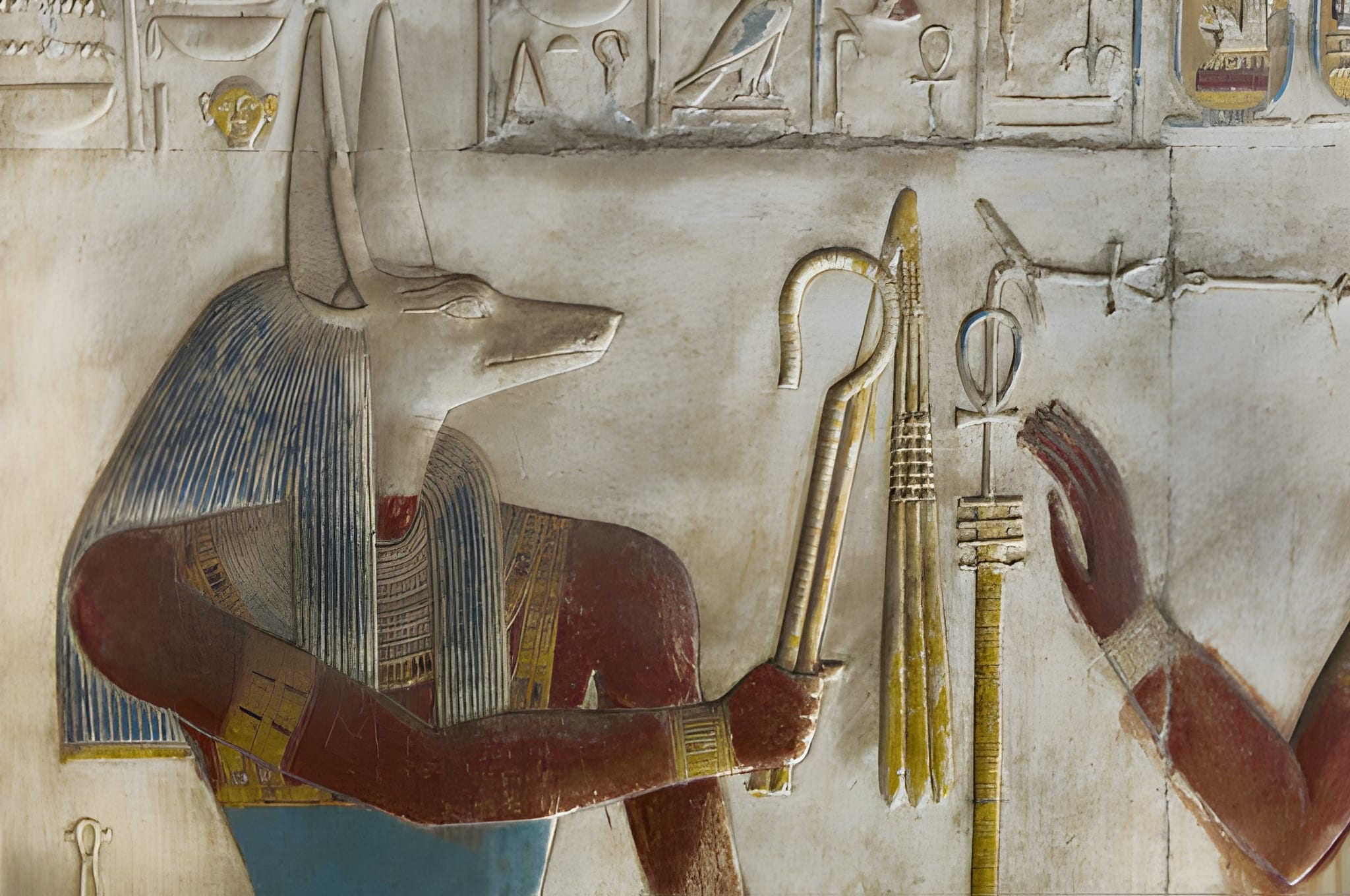
Embalming was a profession with its own ranks, its own workshops and its own reputation. The texts name a chief embalmer who acted the part of Anubis, the jackal-headed god of the embalming tent, and in some depictions he wears a jackal mask while the wrapping is done. Below him worked cutters, who made the incision, and bandagers, who did the slow part.
The job carried a double status. The work was sacred, and the people who did it handled corpses for a living, which in most societies is a reason to keep your distance. Egyptian sources manage to express both attitudes at once.
What the Texts Say and What the Bodies Show
Much of what is repeated about mummification comes from Greek writers, above all Herodotus, who described three price levels of the service centuries after the New Kingdom workshops had closed. His account is useful and it is second hand.
The bodies themselves are the better source. Modern scanning of royal mummies has corrected the written record repeatedly: packing materials where the texts describe none, organs left in place that should have been removed, amulets in positions that do not match the manuals, and repairs made by later priests who rewrapped damaged mummies and moved them for safekeeping. The practice varied by period, by workshop and by budget, which is exactly what you would expect of a trade.
Animal Mummies
Humans were not the only ones preserved. Millions of animal mummies survive: ibises, cats, crocodiles, falcons, bulls and dogs, prepared as offerings to the god each species represented and sold to pilgrims at temple sites. Whole catacombs of them have been excavated at Saqqara.
Scanning has shown that a share of the bundles sold as mummies contain feathers, reeds or nothing at all, which tells you that supply did not always keep up with demand.
Who Was Mummified, and Who Was Not
Full mummification was expensive. Royalty and the elite received the complete treatment; lower-ranking people received simplified versions, and the poorest were buried in the desert sand, where the dryness preserved bodies naturally. That natural preservation almost certainly gave the Egyptians the idea in the first place.
Where to See the Evidence Today
The royal mummies are displayed in the National Museum of Egyptian Civilization in Cairo, in a hall built for them. Mummification equipment, canopic jars, masks and coffins are shown in the Grand Egyptian Museum and in the Mummification Museum in Luxor, which is built around the process itself.
FAQs About the Steps of Mummification
How long did mummification take?
About seventy days in total, of which roughly forty were the natron drying.
Why was the brain removed and the heart left?
The Egyptians considered the heart the seat of thought and character, and it had to be present for judgment. The brain was not believed to do anything important.
What is natron?
A naturally occurring mixture of salts, collected from dry lake beds, that absorbs moisture. It was the drying agent of the whole process.
What went into canopic jars?
The stomach, the intestines, the lungs and the liver, each under the protection of one of the four sons of Horus.
Were all Egyptians mummified?
No. The full procedure was for those who could pay. Simplified versions existed, and the poorest were buried directly in the desert, where bodies dried naturally.
What is the Opening of the Mouth ceremony?
A ritual performed at the tomb entrance to restore the senses of the dead, allowing them to eat, speak and breathe in the afterlife.
Where can I see mummies in Egypt?
The National Museum of Egyptian Civilization in Cairo holds the royal mummies. The Mummification Museum in Luxor explains the process, and tomb groups in the Grand Egyptian Museum show the equipment and the coffins.
Final Word: A Procedure, Not a Superstition
Read the seven steps as engineering in the service of theology. Every stage removes a cause of decay or restores something the removal cost: moisture out, shape back; organs out, protection in; senses lost, senses ritually returned. That combination of practical method and absolute conviction is what makes Egyptian funerary culture so strange and so coherent at the same time.
To see Saqqara and the Grand Egyptian Museum in one day, join our Pyramids, Saqqara, and the Grand Egyptian Museum Experience.